
Microcement Colours: A Full Guide for Contractors, Designers & Developers
Choosing the right microcement colours is rarely the first thing on a contractor’s mind when quoting a job. But it should be. The colour you specify affects coverage rates, labour time, touch-up difficulty, and how the final surface reads under different lighting. For designers, colour determines whether a seamless wall feels warm, industrial, or luxurious. For developers and distributors, colour choice impacts inventory complexity and project consistency across multiple units.
This guide breaks down microcement colours from a practical, project-level perspective—what affects colour consistency, how different finishes behave, and how to match the right colour system to your specific application.
01.Why Microcement Colour Selection Matters More Than You Think
Microcement is a thin-layer decorative coating applied over existing substrates. Unlike paint, it is not a flat colour film. It is a textured, layered system where colour is influenced by the base coat, the top coat, and the trowel or spray technique used. Two projects using the same colour can look completely different if the application method or the number of layers changes.
For contractors, this means colour is not just an aesthetic choice—it is a variable that affects rework risk. For designers, it is the difference between a signature finish and a generic grey wall. For developers, it is about repeatability: if you are finishing 200 apartment units, every unit needs to look the same.
Understanding how microcement colours behave across different substrates, lighting conditions, and application methods is essential before you specify, order, or apply.
02.The Core Factors That Change How Microcement Colours Look
1. Substrate Colour and Texture
Microcement is translucent to a degree. The base layer—whether it is over tiles, gypsum board, or old paint—can influence the final colour. A dark substrate can darken the finish; a glossy tile can cause uneven absorption. Contractors should always apply a proper primer or base coat to neutralise the substrate before the colour layers go on.
2. Number of Coats and Thickness
More coats mean deeper, richer colour. Fewer coats mean the finish is thinner and the substrate may show through. This is not a defect—it is a design variable. But it must be planned. If a designer expects a deep charcoal tone but the contractor applies only two thin coats, the result will be uneven. Specify the number of coats in the project documentation, not just the colour name.
3. Trowel vs. Spray Application

Trowel application creates subtle tonal variations because the pressure and angle of the blade vary slightly across the surface. This is desirable for a handcrafted look. Spray application is more uniform, which is better for large areas where consistency matters more than texture. The same colour can look different depending on which method you use.
4. Sealer and Top Coat Finish
Microcement colours change once a sealer is applied. A matte sealer preserves the raw,mineral look. A satin or gloss sealer deepens the colour and adds richness. The sealer also affects how light reflects off the surface, which changes how the colour is perceived throughout the day. Always test the sealer over the actual colour before committing to a full project.
5. Lighting Conditions
Natural daylight, warm LED, and cool fluorescent light all render microcement colours differently. A grey that looks balanced in a showroom can look cold in a north-facing corridor. Designers should request physical samples and view them under the actual lighting conditions of the project site before finalising the colour schedule.
03.Microcement Colours vs. Traditional Paint Colours: A Practical Comparison
This table is not about which is “better.” It is about understanding what you are committing to when you specify microcement colours. If your project needs seamless surfaces, high durability, and a premium finish, microcement is the right choice. If you need fast, low-cost coverage over large areas, paint may be more practical.
04.How to Choose the Right Microcement Colour System for Your Project
For Contractors: Prioritise Consistency and Repairability
Your main concern is delivering a uniform finish without callbacks. Choose a colour system that is available in a full range of tones but is also consistent across batches. Ask your supplier about batch-to-batch colour variation. If you are working on a large project, order all material for the job at once to minimise variation.
Also, consider the repair issue. If a wall gets damaged after handover, can you match the colour? Some suppliers offer colour codes that allow you to order a small batch for touch-ups. This is critical for commercial projects where you may be liable for maintenance for months after completion.
For Designers: Focus on Texture and Light Interaction

You are not just choosing a colour—you are choosing how that colour interacts with texture and light. Request physical samples, not just digital swatches. Look at the sample under warm and cool light. Apply a sealer on half the sample to see how the finish changes. If you are specifying a colour for a feature wall, consider how the texture will cast shadows. A smooth, fine texture will show colour more evenly; a coarse texture will create subtle tonal shifts that can be very striking.
For Developers and Distributors: Think About Inventory and Standardisation
If you are managing multiple units or projects, you need a colour system that is easy to standardise. Choose a supplier that offers a defined colour palette, not an unlimited custom colour range. This simplifies procurement, reduces inventory risk, and ensures that the same colour can be supplied for years to come. Ask about the supplier’s colour consistency across production batches and whether they can guarantee the same colour for future phases of your project.
05.Common Mistakes When Specifying Microcement Colours
Mistake 1: Choosing colour from a screen. Digital screens render colours differently. What looks like warm beige on your monitor can appear grey or pink on site. Always use physical colour cards or samples.
Mistake 2: Ignoring the sealer effect. The sealer changes the colour. If you have not seen the colour with the final sealer applied, you have not seen the final colour.
Mistake 3: Assuming all grey is the same. Grey is the most popular microcement colour, but it is also the most variable. Warm grey, cool grey, green-grey, blue-grey—these are all different products. Specify the exact tone, not just “grey.”
Mistake 4: Not testing on the actual substrate. Microcement behaves differently over tile, gypsum, and concrete. Test your colour on the same substrate you will use on site.
Mistake 5: Forgetting about repair and maintenance. Some colours are easier to touch up than others. Lighter, neutral tones are more forgiving. Very dark or very saturated colours are harder to match if repair is needed.
06.How to Test Microcement Colours Before Committing
A proper colour test takes less than a day and can save you from a costly mistake. Here is a simple process:
1. Prepare a sample board using the same substrate as your project (e.g., tile, gypsum, or concrete).
2. Apply the full system—primer, base coat, colour layers, and sealer—exactly as you would on site.
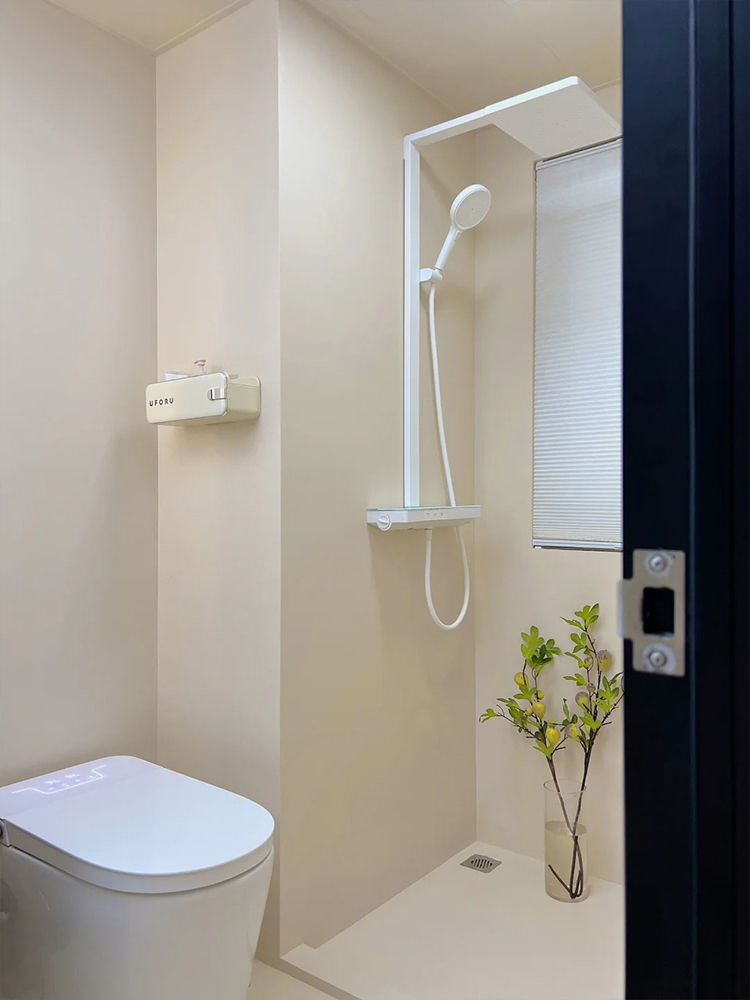
3. View the sample under different lighting—natural daylight, warm light, and cool light.
4. Scratch and scrape the sample to see how it handles wear and whether the colour wears evenly.
5. Attempt a touch-up on a small area to see if the colour blends or shows a patch.
This test gives you confidence that the colour you specify will perform as expected, and it helps you communicate clearly with your client about what the final result will look like.
07.Why Choose Us
THE AIKE Paint is a manufacturer of high-quality water-based decorative coatings, including a full range of microcement products. Our microcement system is designed with the practical needs of contractors, designers, and developers in mind.
Consistent Colour Across Batches: Our microcement colours are produced under strict quality control, ensuring that the colour you specify today will match the colour you receive next year. This is essential for multi-phase projects and ongoing maintenance.
Full-Scene Application System: Our microcement works on walls, floors, bathrooms, kitchens, and commercial spaces. One product system covers your entire project, simplifying procurement and ensuring uniform colour and texture across all surfaces.
Eco-Friendly, Low-VOC Formula: Our water-based microcement meets global green building standards, making it suitable for high-end residential and commercial projects in Europe, the Middle East, and North America.
Technical Support for Colour and Application: Our senior team provides full-process guidance, from colour selection to application technique, helping you avoid common mistakes and deliver a flawless finish.
Whether you are a contractor bidding on a renovation project, a designer specifying a feature wall, or a developer standardising finishes across multiple units, we can help you choose the right microcement colours and apply them with confidence.
Contact us today for a free product sample and a customised colour consultation for your next project.
“ Contact AIKE Team ”
__________
在线留言
Name*
E-mail*
Country*
Application Areas*
Tel / WhatsApp
Requirement
Business Supervisor:Mr. Bin Zhu


Social media account


